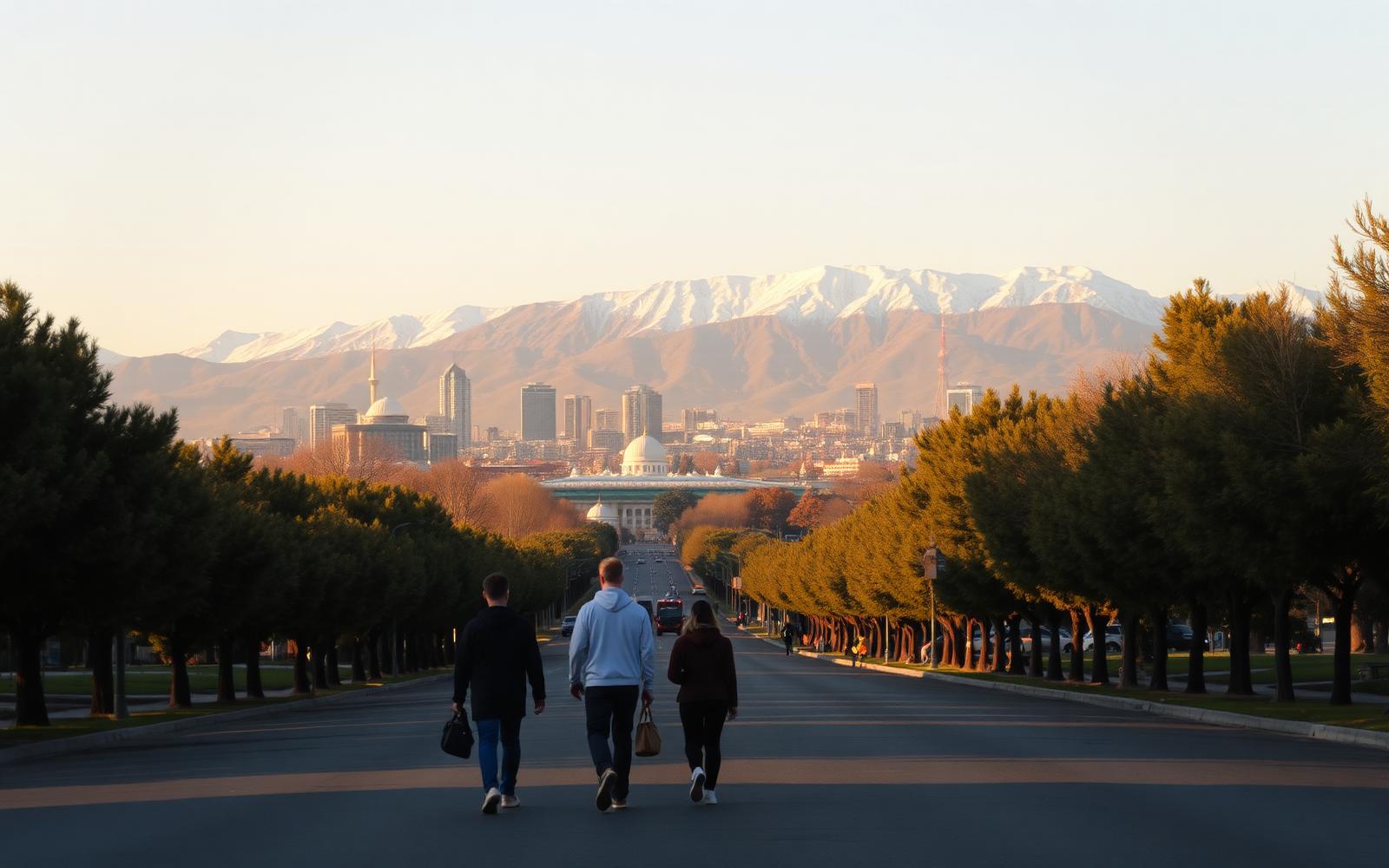
Tehran holds around 9 million people inside the city and close to 15 million across the metro area, and a very large share of them arrived from somewhere else — for university, for work, for family. That is the paradox newcomers run into immediately: the city is intensely social and extremely private at the same time. Almost everyone is embedded in a dense network of family and old school friends, and almost nothing about that network is visible from the street.
The first thing to understand is the north–south axis, because it shapes every social decision here. Valiasr Street runs nearly 18 kilometres from Tajrish in the north to the railway station in the south, and the further north you go the cooler, greener and more cafe-dense the city becomes. Tajrish, Shemiran, Zafaraniyeh and Elahiyeh sit at the foot of the Alborz and give you mountain access within a metro ride. Vanak, Jordan (Nelson Mandela Blvd) and Sa'adat Abad are where the young professional crowd works, eats and lingers. Yousefabad and Amirabad are the classic student-and-creative belt. Downtown around Enghelab Square is bookshops, universities, bazaar edges and the oldest cafes in the city.
The three reliable routes in
Route one is the mountains. Darband and Tochal are inside the city limits — you can take the metro to Tajrish, walk up through the teahouses at Darband, and be on a proper trail within the hour. Friday mornings the trails are full of groups, and Iranian hiking etiquette makes conversation with strangers almost automatic. Tochal's telecabin and Station 7 crowd is the friendliest social scene in Tehran that costs almost nothing to join.
Route two is cafes. Tehran's independent cafe scene is one of the best in the region, and it functions socially the way pubs do elsewhere: you pick one, you go weekly, the staff learn your order, and after a month you know the other regulars. Karim Khan, Yousefabad, Enghelab and Gandhi Street each have clusters worth trying.
Route three is anything with a fixed weekly slot: a language exchange, a photography workshop, a climbing gym, a futsal team, a calligraphy or setar class, a volunteer group. In a city where alcohol-centred nightlife does not exist, structured hobbies carry the social load — and that is genuinely an advantage, because shared activity produces closer friendships than shared drinking does.
What to expect socially
Expect warmth immediately and depth slowly. Expect ta'arof — the ritual politeness of offering, declining and offering again — and do not read a first refusal as a real no. Expect invitations to homes rather than venues; the living room, not the bar, is Tehran's main social space. Expect group chats to matter enormously: almost every hiking group, class and cafe crowd runs on one, and being added is the real signal that you are in.
Practical notes
The metro is fast, cheap and the easiest way to cross the north–south divide; Line 1 runs from Tajrish most of the way down. Air quality is worst in late autumn and winter, so outdoor plans shift to mornings and higher altitude. Fridays are the weekend day everything social happens; Thursday evenings are the equivalent of a Friday night elsewhere. And two arrangements to remember: nothing here is spontaneous until you are inside a group, and everything is spontaneous once you are.