If you have typed "best apps to meet friends" into a search bar recently, you already know the problem. Every list looks the same, every app promises the same thing, and almost none of them tell you what actually happens after you download it.
So let's do the version nobody writes: three apps, side by side, judged on the only metric that matters — how often they turn into a real person you actually see again.
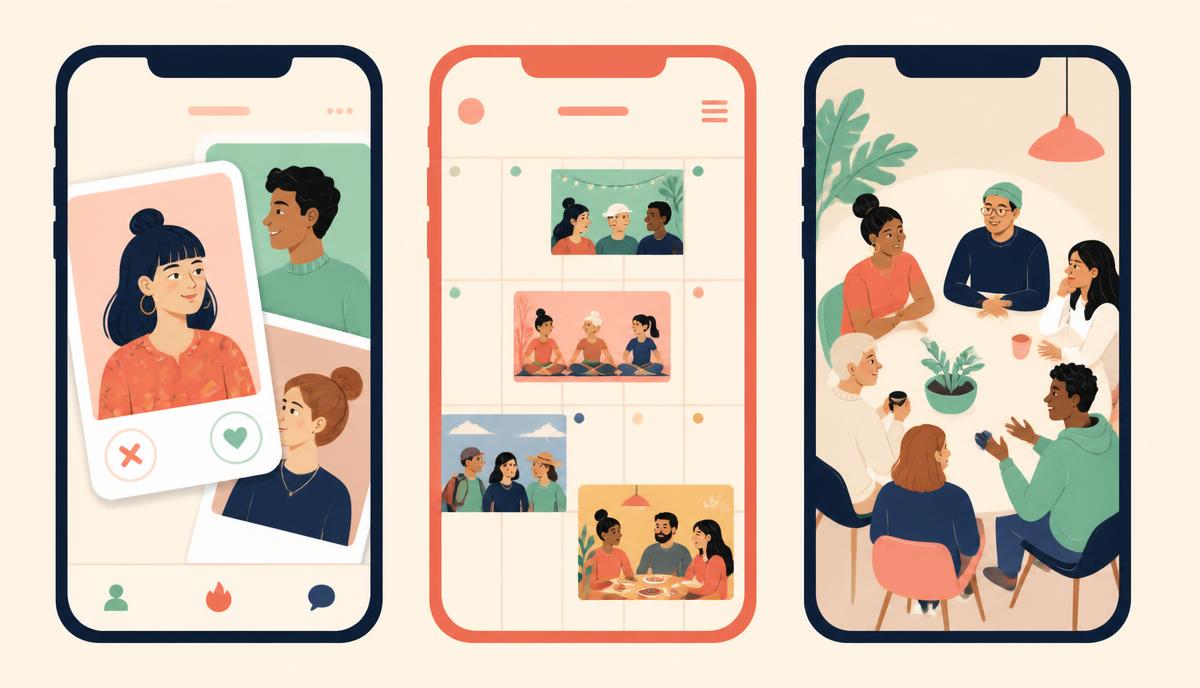
We picked these three because they represent the three genuinely different strategies for making friends as an adult. Bumble For Friends (still called Bumble BFF by almost everyone) is the matching model. Meetup is the group model. Pulse Now is the plan model. Everything else on the market is a variation on one of them.
The 60-second comparison
| Bumble For Friends | Meetup | Pulse Now | |
|---|---|---|---|
| Core model | Swipe, match, chat 1-to-1 | Browse public groups and events | Matched into a small group, then given a real plan |
| Who's on it | Skews 22–35, heavily women, big-city dense | Widest age range of the three, 30–60 core, hobby-led | Skews 25–40, newcomers, movers and rebuilders |
| Free tier | Fully usable | Fully usable; most events free or low-cost | Fully usable |
| Paid tier | Bumble Premium, roughly $18–30/mo | Free to attend; $16–30/mo only if you organise | Optional premium events, priced per event |
| Effort to first hangout | High — you arrange everything | Medium — the event exists, you just turn up | Low — group, icebreaker and activity are set for you |
| Typical failure mode | The chat that never becomes a plan | The event you attend and speak to nobody | Fewer cities than the big two |
| Best for | Wanting control over who you meet | Having one specific hobby to build around | Wanting to meet people this week without organising it |
Bumble For Friends: great at matching, bad at meeting
Bumble For Friends does one thing better than anything else on this list: it finds you people you would plausibly like.
The interface is familiar because it is the dating app you already know, minus the romance. You see a profile, you swipe, and if you both swipe you get a chat. The profiles are rich, the photos are real, and the matching is genuinely decent at surfacing people with overlapping interests and a similar life stage.
Demographics. It is by far the youngest-skewing of the three, concentrated in the 22–35 range, and noticeably majority-women — which makes it excellent for women looking for other women and considerably slower for men in smaller markets. Density collapses fast outside major cities. In London or New York you will never run out of profiles. In a mid-sized city you can exhaust the deck in a weekend.
Cost. The free tier is genuinely usable. Bumble Premium (roughly $18–30 a month depending on your market and term) adds unlimited swipes, rewinds, and visibility boosts. You do not need it to make a friend; you need it to swipe faster.
Ease of use. Downloading it and getting a match is the easiest experience of the three. Turning that match into a Tuesday evening is the hardest.
That is the honest catch. Bumble For Friends hands you a chat window and wishes you luck. Somebody has to propose a place, propose a time, and risk the rejection of being told no — and in a friendship context, where neither person feels any romantic urgency, that somebody frequently ends up being nobody. The match rots in the inbox. Most people we hear from have a dozen of these.
Verdict: the best tool here for finding candidates, the worst for converting them.
Meetup: the hobby is doing the heavy lifting
Meetup is the oldest platform on this list and its model has barely changed, because for one specific use case it still works.
You do not match with people on Meetup. You find a group — hiking, board games, Python, salsa, book club — and you show up to its events. The friendship is a side effect of repeatedly being in a room with the same people around a shared activity, which happens to be exactly how friendships formed for most of human history.
Demographics. The widest age spread of the three, with a core in the 30–60 band, and generally more balanced by gender than Bumble For Friends. The composition is entirely dictated by the group: a climbing meetup and a genealogy meetup are different worlds. Coverage is strong in large cities and thin-to-nonexistent in small ones.
Cost. Free to browse and join. Individual events range from free to the cost of a class or a venue. The subscription (around $16–30/mo) only applies if you want to organise a group, which most people never do.
Ease of use. Simple to browse, and the events are real and already scheduled — that removes the coordination problem that kills Bumble For Friends. What it does not remove is the walking-in problem.
This is Meetup's real weakness. A twenty-person open event has no structure to it. There is no host obliged to introduce you, no seating plan, no icebreaker. Groups that have existed for years have their own cliques. It is entirely possible — extremely common, actually — to attend three events and go home having exchanged four sentences. Quality also swings wildly with the organiser: a great one makes a great group, and there is no way to tell from the listing which you are getting.
Verdict: unbeatable if you have one clear hobby and can commit to showing up repeatedly. Rough if you are hoping the room does the work.
Pulse Now: skipping the chat entirely
Pulse Now starts from the observation that the chat is the failure point, so it removes it.
Instead of matching you with one person, it matches you into a small group of like-minded people near you. It then breaks the ice for the group and helps you settle on a real-world activity together. You are not negotiating with a stranger about whether to get coffee — you are one of five or six people with a plan already forming. It also runs curated premium events and lets members create or join user-generated plans.
Demographics. Skews 25–40, with a heavy concentration of people in transition: recent movers, people out of a long relationship, remote workers, arrivals in a new country. In other words, people with an urgent, specific need rather than casual browsers — which meaningfully raises the odds that everyone in the group actually turns up.
Cost. Free to join and be matched. Premium curated events are priced individually rather than by subscription, so you pay for the specific dinner or activity you want.
Ease of use. The lowest-effort path to a real hangout of the three, precisely because the two hardest steps — deciding who and deciding what — are already done. The group format also removes the pressure of a one-on-one with a stranger; if you and one person do not click, there are still four others at the table.
The honest limitation: it is live in fewer cities than Meetup or Bumble. Coverage is expanding, but check your city first. It is also, by design, not a browsing app — you get matched rather than picking from a deck, which some people dislike.
Verdict: the highest conversion rate from "downloaded an app" to "sat across from a human being", if it runs where you live.
So which one should you actually download?
Stop asking which app is best and ask which failure mode you are most likely to hit.
- You are shy about groups and want to vet people first → Bumble For Friends. Accept that you must propose the first plan, and propose it inside three messages.
- You have one real hobby and can go every week → Meetup. Pick one group and attend four times before judging it. The fourth visit is where people start recognising you.
- You are new in town, or you just want to meet people this month without running the logistics → Pulse Now, if your city is covered.
- You want the highest odds overall → run Pulse Now and one Meetup group in parallel. They fail in opposite directions, so together they cover each other.
The one thing all three have in common: none of them work from the sofa. Every model on this list still requires you to leave the house on a specific evening. The apps differ only in how much friction stands between you and that evening — and that, not the size of the user base, is what you should be comparing.
For the full picture, we keep a running breakdown of every option — including Timeleft, Peanut, Patook, Atleto and Nextdoor — on our best apps for making new friends page, plus city-by-city guides for 92 cities around the world.